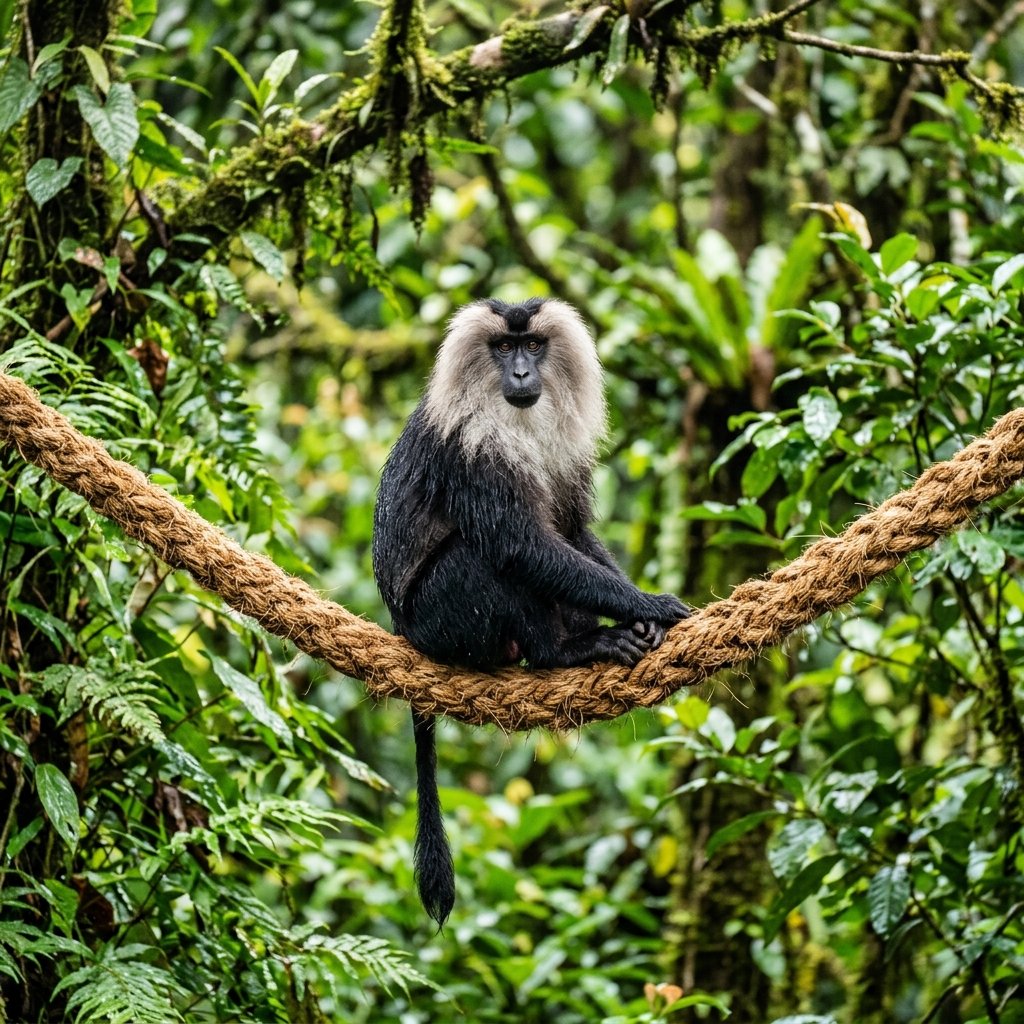
High in the emerald ceilings of the Valparai plateau, a rare, silver-maned primate sits perched on a branch. The **Lion-tailed Macaque** (*Macaca silenus*) is an animal crafted entirely for a life in the sky. With its distinct grey mane surrounding a dark face and a tufted tail resembling that of a lion, this endangered species spends nearly its entire life in the dense evergreen canopy of the Southern Western Ghats, rarely setting foot on the forest floor.
However, the modern landscape has fractured this vertical world. Over the last century, sprawling tea and cardamom estates have carved deep roads through the rainforest, severing once-continuous tree canopies. For an animal that refuses to touch the ground, these road gaps are impassable barriers. To move from one patch of forest to another in search of seasonal fruits, the macaques are increasingly forced to descend, exposing themselves to speeding tourist vehicles and feral dogs.
"An arboreal primate on the forest floor is a creature out of its element, vulnerable and stranded. By reconnecting the canopy, we restore their sovereignty over the skies."
The Canopy Fragmentation Crisis
Habitat fragmentation is one of the most silent yet destructive forces facing the Western Ghats. In Valparai, where rainforest fragments are nestled within a sea of plantations, canopy-dwelling animals are particularly affected. Unlike larger terrestrial animals that can cross roads, species like the Lion-tailed Macaque, Nilgiri langur, Malabar giant squirrel, and various flying squirrels depend on overlapping tree branches to navigate their home ranges.
When a road is widened or a single tall tree falls at a roadside edge, the canopy link is broken. If a macaque troop is separated from its feeding trees, the genetic isolation can lead to inbreeding depression and eventual local extinction. When forced down to the road, they face immense danger. Roadkills have historically claimed the lives of numerous breeding adults, a heavy blow for a species whose numbers are already hovering around just a few thousand in the wild.
The Vulnerability of a Canopy Specialist
The Lion-tailed Macaque has a extremely slow reproductive rate. Females give birth to a single infant only once every three years, and do not reach breeding age until they are six. Losing even a single individual to a vehicular collision can trigger the decline of an entire wild troop.
The Coir Rope Solution: Simple, Low-Tech, Effective
While high-tech solutions like concrete wildlife overpasses are often proposed for highways, they cost millions, require heavy machinery that destroys local vegetation, and take years to construct. In the sensitive, high-canopy habitats of Valparai, a far simpler and incredibly elegant indigenous solution has emerged: canopy bridges woven from organic coir rope.
These bridges are essentially thick, ladder-like structures hand-woven from coir (coconut fiber), which is highly resistant to monsoon rot and blends naturally into the forest. Constructed by local community groups and forest watchers, these bridges are suspended between tall, sturdy trees on either side of the road, high above the reach of heavy trucks.
Over time, natural moss, ferns, and creepers grow over the coir fiber, turning these structures into living "canopy highways" that look identical to thick forest vines.
| Feature | Concrete Wildlife Overpasses | Community Coir Rope Bridges |
|---|---|---|
| Primary Target | Large terrestrial wildlife (elephants, tigers) | Arboreal species (macaques, squirrels) |
| Materials | Reinforced concrete, iron, soil, asphalt | Organic coconut coir rope, steel cable cores |
| Environmental Footprint | High (requires clearing wide forest tracks) | Near zero (tied manually to existing trees) |
| Installation Time | 12 to 24 months | 2 to 3 days |
| Relative Cost | Extremely high (tens of lakhs) | Very low (minimal community materials) |
| Ecological Integration | Artificial landscape requiring massive replanting | Blends with vines; overgrown by creepers in months |
Restoring the Aerial Corridors
The success of these coir rope bridges lies in how quickly the local wildlife has adopted them. Initially hesitant, alpha males of the macaque troops were observed testing the structures. Within weeks, entire troops—including mothers carrying tiny infants—began using the coir walkways to cross busy plantation roads without ever coming down from the canopy.
The benefits have extended far beyond the Lion-tailed Macaques:
- Nilgiri Langurs: These heavy folivorous primates use the bridges to safely access seasonal feeding territories.
- Malabar Giant Squirrels: Known for their acrobatic leaps, these squirrels use the ropes as a stable highway during high-wind monsoon periods when tree jumping is dangerous.
- Nocturnal Gliders: Flying squirrels and slender lorises utilize the bridges under the cover of darkness, avoiding the bright headlights of night vehicles.
A Future Woven by Communities
The maintenance of these aerial corridors is a beautiful example of citizen-led conservation. Because Valparai’s forests are tightly woven with private tea estates, plantation owners, local workers, and forest department staff work hand-in-hand. Watchers check the bridges quarterly, especially after the heavy South-West monsoon, to ensure the anchors remain secure and no branches have fallen across them.
By treating the canopy not as empty space, but as a critical, three-dimensional habitat that requires active restoration, these simple coir ropes are proving that the most effective conservation solutions are often those that mimic the gentle, organic hand of nature itself.