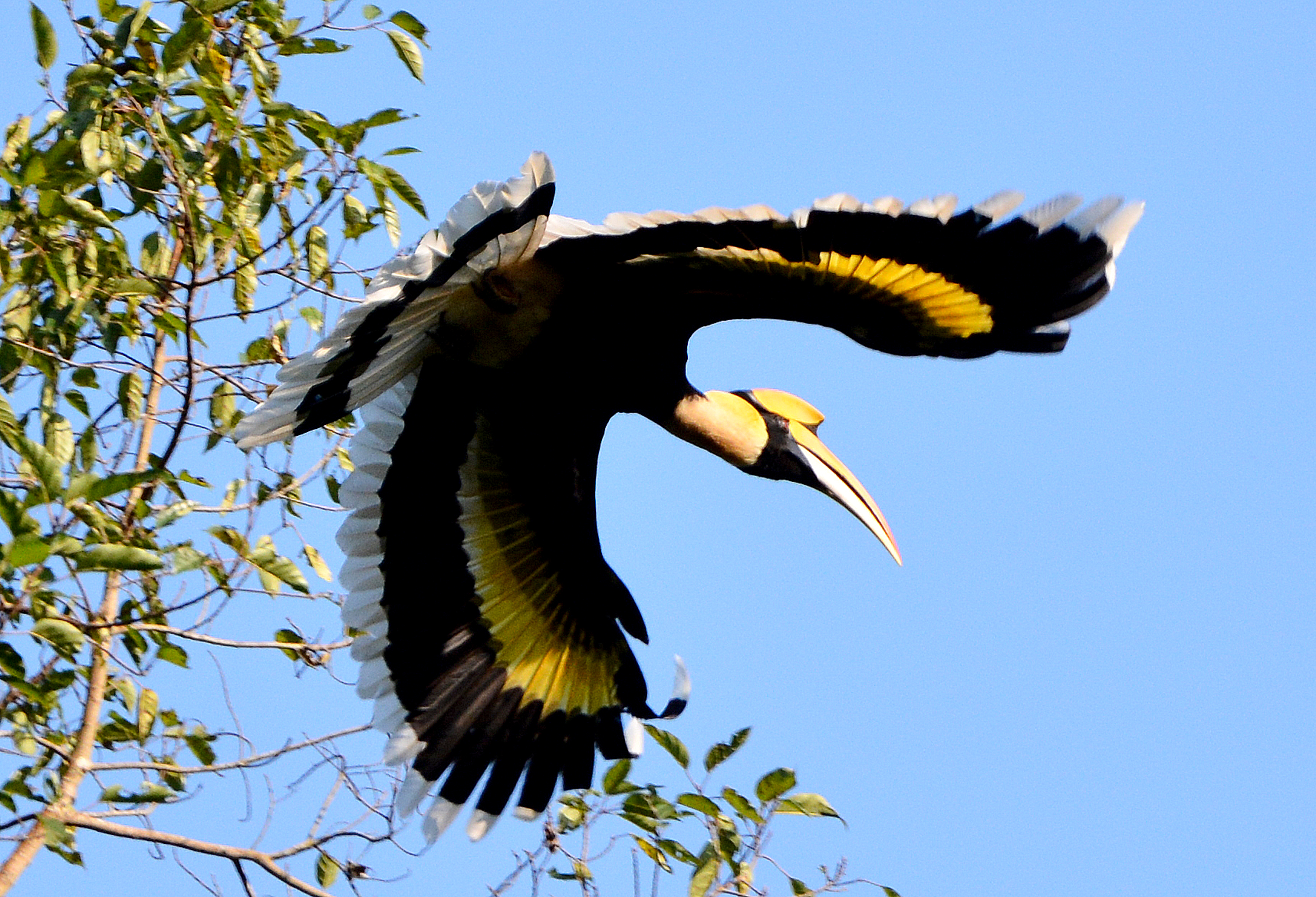
A deep, repeating whoosh echoes through the misty canopy of the Vazhachal forests, followed by a resonant, barking call. It is the unmistakable sound of the **Great Indian Hornbill** (*Buceros bicornis*). With its massive golden-yellow helmet-like casque, deep black-and-white wings, and a wingspan exceeding five feet, the hornbill is the uncontested monarch of the evergreen rainforest ceiling.
Yet these magnificent birds are far more than beautiful sights—they are the literal "farmers of the forest." Possessing an extremely specialized diet consisting almost entirely of forest figs and fleshy wild nutmeg fruits, they fly vast distances across the valleys, dispersing seeds that are too large for other birds to swallow. By dropping these seeds across fragmented forest sectors, they drive the natural regeneration of the entire Western Ghats.
"Without the hornbill, the grand hardwood giants of our forests would have no way to seed the next generation. They are the winged architects of the Sahyadri mountains."
The Sealed Sanctuary: An Extraordinary Nesting Biology
The life cycle of the hornbill is defined by an extraordinary, highly secretive breeding ritual. Great Indian Hornbills are strictly monogamous, mating for life. To nest, they require massive, old-growth hardwood trees—such as the native ironwood (*Mesua ferrea*) or wild cotton trees—which feature natural hollows located thirty to eighty feet above the ground.
Once a nesting hollow is chosen, the female enters the cavity and proceeds to do something remarkable: she seals herself inside. Using a paste of mud, wood pulp, fruit feces, and clay provided by the male, she blocks the entrance of the cavity, leaving only a tiny vertical slit.
For nearly four months, the female remain locked in complete darkness, shedding her flight feathers and incubating her eggs. She is entirely dependent on the male, who must fly back and forth dozens of times a day to feed her and the growing chicks through the narrow slit. If the male is shot by poachers or if the tree is logged during this critical window, both the sealed female and her chicks will slowly starve to death.
Did You Know?
Because the female hornbill sheds her flight feathers while sealed inside the nest, she is completely flightless and defenseless during the breeding cycle. If a predator breaches the nest, or if the male fails to return, she has no escape.
The Conflict: Stranded Monarchs
Over the last five decades, the survival of these canopy giants has been pushed to a razor's edge. Commercial logging has stripped the forests of the massive, century-old trees that feature the hollows necessary for hornbill nesting. Smaller trees simply do not have cavities large enough to accommodate a nesting female.
At the same time, historically, hornbills faced intense pressure from poaching. Local tribes hunted the birds for their heavy casques, which were valued as traditional headgear and ornaments, and captured chicks for local trade. As nesting trees vanished and poachers targeted breeding males, nesting success rates plummeted, threatening to silence the great whooshing wingbeats forever.
The Solution: Kadar Tribal Nest Guardians
The turnaround of the Vazhachal hornbills is a spectacular story of indigenous-led conservation. Launched in the early 2000s, the **Hornbill Nest Guardian Program** turned the very communities that once hunted the birds into their ultimate defenders.
The **Kadar tribe**—an ancient, forest-dwelling community native to the Anamalai hills—possesses an unparalleled, intimate knowledge of the canopy. Members of the community can scale eighty-foot vertical trees with ease using traditional bamboo ladders and identify nesting cavities by smell and subtle bark markings.
Under the program, local Kadar youths are employed as professional Nest Guardians. During the nesting season from December to April, these guardians monitor nesting cavities daily, keeping detailed logs of feeding frequencies, tracking the health of breeding pairs, and physically protecting the trees from illegal logging and poachers.
| Conservation Metric | Before Kadar Guardian Program (Pre-2003) | With Kadar Guardian Program (2025-2026 Status) |
|---|---|---|
| Annual Nesting Success Rate | Below 40% (high poaching & disturbance) | Stable 95% to 100% in monitored cavities |
| Illegal Nesting Tree Logging | Frequent (unmonitored forest sectors) | Zero incidents in Kadar patrol zones |
| Poaching Incidents | Common (birds targeted for casques/meat) | Zero poaching of nesting pairs in Vazhachal |
| Active Monitored Cavities | Fewer than 12 recorded pairs | Over 45 active, protected nest sites |
| Community Income Source | Unstable, seasonal forest labor or hunting | Dignified, steady conservation salaries |
A Triumph of Shared Stewardship
The results have been spectacular. In the Vazhachal forest division, monitored nesting cavities have achieved a near-perfect nesting success rate for several consecutive years. By ensuring that breeding males can forage in peace without the threat of catapults or guns, the Kadar guardians have successfully allowed scores of young hornbills to fledge and take to the skies.
This program has achieved something far deeper than species protection: it has restored the community's ancestral connection to the forest. Today, the Kadar people view the hornbills not as wild animals to be exploited, but as close kin whose high-canopy nests are sacred trusts.
By proving that the best guardians of the forest are the very people who have shared its shade for millennia, this simple, tribal-led program has created a shining, global blueprint for how modern science and ancient forest wisdom can stand together to protect the giants of our earth.