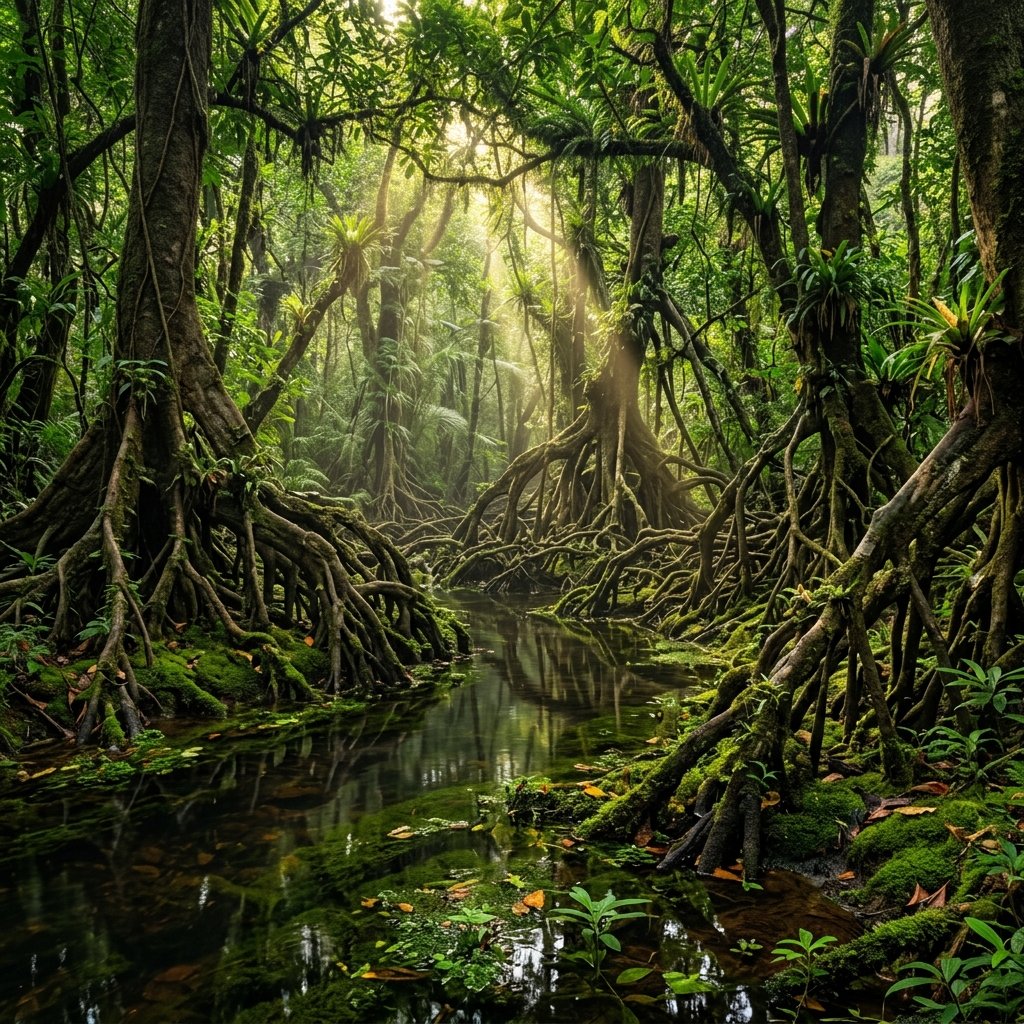
To step into a **Myristica swamp** is to step across millions of years of evolutionary history. Located in the deeply shaded valleys of the southern Western Ghats, these ancient, waterlogged ecosystems are dominated by trees with bizarre, twisting stilt-roots and knee-like breathing roots rising from the dark, muddy water. These trees belong to the *Myristicaceae* family—a primitive group of wild nutmegs that dates back to the Cretaceous period, when dinosaurs still walked the earth.
These swamps are not mere wetlands; they are biological time capsules. Having survived the mass extinction that wiped out the dinosaurs and withstood massive global climate shifts, they now persist in tiny, fragmented pockets along mountain streams. However, their true value to the modern world is not just their age, but their staggering hydrological power. They are the ultimate natural sponges of the Western Ghats.
"The Myristica swamps are the kidneys of our hills. They filter our waters, absorb our monsoons, and feed our summer streams. Protecting them is an act of self-preservation."
The Cretaceous Sponge: Hydrological Giants
The physical structure of a Myristica swamp is perfectly designed to manage water. The thick networks of stilt roots and looping pneumatophores (breathing roots) form an incredibly dense, subterranean grid. During the heavy South-West monsoon, when torrential rainfall lashes the Sahyadri mountains, these swamps act as primary flood-mitigation basins. They capture, slow down, and absorb massive volumes of surface runoff.
Instead of allowing monsoon waters to flash-flood down the valleys—carrying away fertile topsoil—the swamps hold the water in place. The rich organic clay soils filter out sediments and impurities. Then, during the grueling, hot summer months from March to May, the swamps slowly and rhythmically release this clean, stored water back into downstream rivers. Without these swamps, dozens of perennial rivers in Kerala and Karnataka would dry up completely in the summer.
The Magic of Breathing Roots
Because swamp water is highly waterlogged and depleted of oxygen, Myristica trees cannot breathe through underground roots. To survive, they have evolved looping 'knee roots' and stilt roots that rise out of the mud and absorb air directly from the atmosphere through specialized pores called lenticels.
An Ecosystem at the Brink
Despite their immense ecological importance, Myristica swamps are among the most threatened habitats on the planet. Because they occupy flat valley floors with year-round freshwater, they have historically been prime targets for human destruction:
- Agricultural Conversion: Wide tracts of swamps have been drained, logged, and converted into commercial paddy fields, rubber, or areca nut plantations.
- Siltation: Deforestation on surrounding hillsides triggers heavy soil erosion. Mud and silt wash down into the valleys, choking the delicate breathing roots of the Myristica trees.
- Invasive Species: The drainage of swamps lowers water tables, allowing invasive terrestrial weeds and exotic fast-growing plants to choke out the native, shade-loving swamp saplings.
| Ecological Metric | Healthy Myristica Swamp | Degraded or Converted Agricultural Land |
|---|---|---|
| Hydrological Behavior | Absorbs monsoon floods; releases summer baseflow | Rapid runoff causing erosion; dry in summer |
| Soil Organic Matter | Extremely high (centuries of leaf decay) | Low (degraded by chemical fertilizers) |
| Vegetation Type | Endemic, stilt-rooted ancient nutmeg trees | Monoculture crops or exotic weeds |
| Water Filtration | High (natural clay grid removes impurities) | Low (leaches agricultural chemicals downstream) |
| Endemic Biodiversity | Host to rare frogs, freshwater fish, and flora | Common generalist species; zero swamp specialist fauna |
Sacred Groves: The Traditional Shield
The survival of the remaining Myristica swamps is deeply rooted in traditional community conservation. In many parts of southern Kerala and Karnataka, these swamps have been protected for centuries as **Sacred Groves** (known locally as *Kavus*). Indigenous and local communities believe these groves are the dwelling places of forest deities, forbidding any logging, farming, or hunting within their boundaries.
This traditional conservation framework has proven highly effective. Modern scientific studies have confirmed that the healthiest Myristica swamps remaining today are almost exclusively those located inside active *Kavus*. The religious taboos against disturbing the groves have protected the soil, water quality, and ancient trees far more effectively than state-imposed forest boundaries.
Weaving Science and Belief for Restoration
Today, active ecological restoration is building upon these traditional foundations. Conservation groups work with local communities to map the hydrology of the swamps and remove invasive weeds that choke the stilt roots. Replanting programs utilize native *Myristica fatua* and *Gymnacranthera canarica* seeds gathered from sacred groves to regenerate degraded areas.
By respecting the sacred nature of these ancient wetlands and combining indigenous stewardship with rigorous restoration hydrology, we can ensure that these primitive, stilt-rooted keepers of the Sahyadri waters continue to anchor the rivers of the Western Ghats for generations to come.