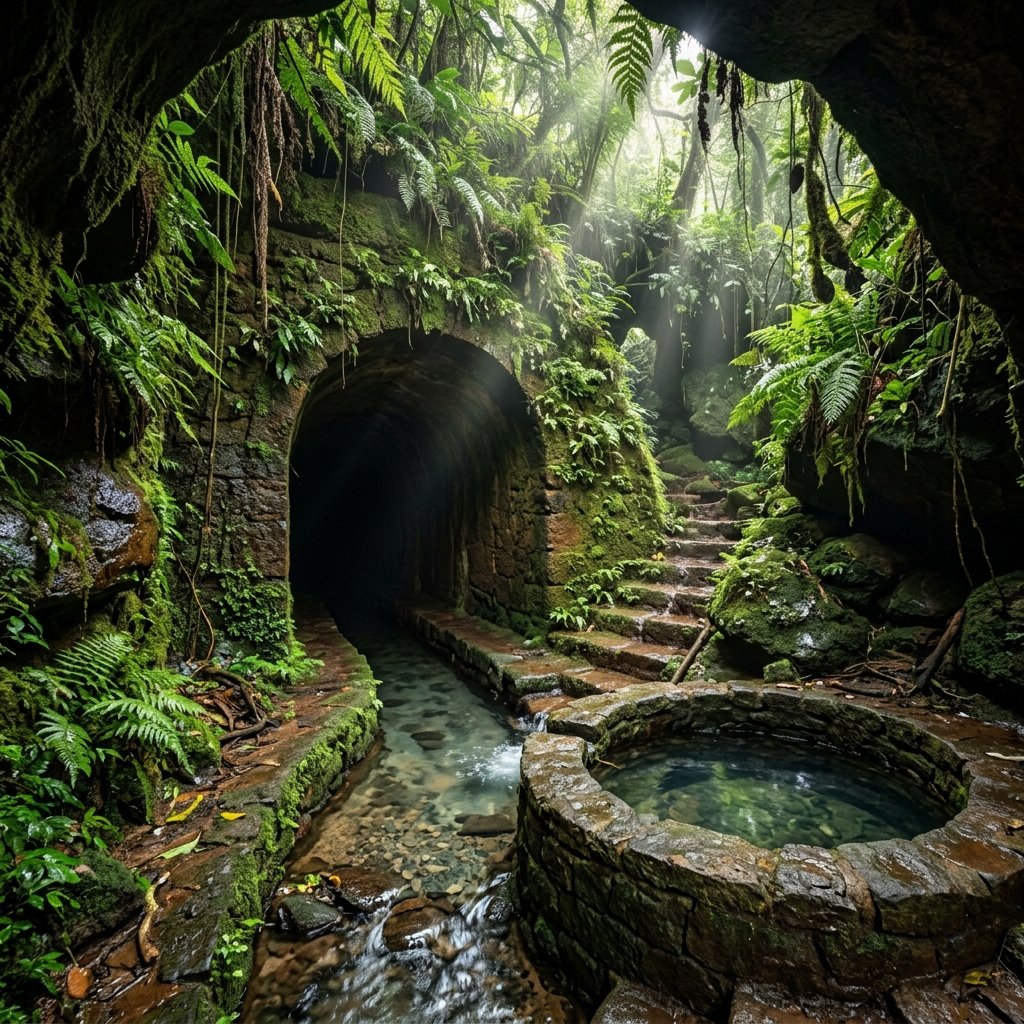
Beneath the sun-baked, red laterite hills of Kasaragod, in the northernmost corner of Kerala, lies a cool and quiet refuge. Stepping inside a narrow, hand-carved opening in the hillside, the temperature drops instantly. Inside this subterranean stone tunnel, there are no electric pumps, no modern pipes, and no hum of machinery. Instead, there is only a slow, rhythmic, and incredibly soothing sound: the steady *drip-drip-drip* of clean water.
This is a **Suranga**—a traditional, horizontal subterranean water tunnel that has provided water security to the rugged laterite slopes of the Western Ghats borderlands for generations. Carved manually into the side of hills using simple chisels, these tunnels tap into the mountain's natural water tables, harvesting water purely by the force of gravity. It is a masterclass in pre-industrial climate resilience.
"The Suranga teaches us that we do not need to rape the earth with deep drills and electric pumps to survive. If we listen to the hills, they will feed us water by gravity."
The Subterranean Hydro-Engineering of Surangas
Surangas are among the most sustainable water-harvesting systems ever devised. In northern Kerala and south-western Karnataka, the hillsides are made of porous laterite rock. This soft, brick-red stone acts as a massive natural sponge. During the monsoons, it absorbs huge volumes of rain, holding the water within tiny fissures and porous pockets deep inside the hills.
Instead of digging a vertical well down from the hilltop—which requires immense energy to pump water up—traditional hydro-artisans dig horizontally into the hill slope. They excavate a narrow, tunnel-like passage that can stretch anywhere from thirty to three hundred feet deep into the rock.
When the tunnel cuts across a natural water-bearing fissure, water begins to seep through the laterite ceiling. It trickles down, accumulates in a shallow, hand-cut stone channel along the tunnel floor, and flows outwards by gravity to a communal collection pond (known as a *Madaka*) built at the base of the hill.
A Living Tunnel that Breathes
Because laterite rock becomes extremely hard when exposed to air but remains soft and easy to chisel when wet, Surangas are self-supporting. The rock naturally hardens along the tunnel ceiling and walls after excavation, eliminating the need for expensive concrete or steel support arches.
The Modern Crisis: Deep Drills and Falling Waters
For centuries, Kasaragod’s farmers and families lived in complete water security, relying on their communal Surangas for both household needs and areca nut farming. However, the post-industrial era brought the spread of deep borewells and electric submersible pumps.
Borewells operate on a logic of extraction rather than harvesting. They drill deep into deep aquifers, drawing up massive volumes of fossil water under high power. Within two decades, the uncontrolled proliferation of commercial borewells depleted Kasaragod’s deep water tables:
- Aquifer Depletion: Deep borewells drained the water tables that sat higher up in the hills, causing hundreds of ancient Surangas to go dry for the first time in history.
- Energy Vulnerability: While Surangas flow 24/7 without grid power, borewells are completely dependent on electricity, leaving crops vulnerable during summer power outages.
- Soil Desiccation: Drawing water out of deep aquifers lowers the soil moisture across the entire hillside, turning green agricultural slopes into dry, arid landscapes.
| Feature | Modern Deep Borewells | Traditional Subterranean Surangas |
|---|---|---|
| Energy Requirement | High (requires electric pumps; constant grid power) | Zero (operates purely on natural gravity) |
| Aquifer Impact | Depletes deep groundwater tables rapidly | Harvests excess seepage; zero aquifer depletion |
| Structural Lifespan | Short (10 to 15 years; siltation and dry-up) | Indefinite (centuries; self-supporting laterite rock) |
| Maintenance Cost | High (pump repair, electricity bills, deep redrills) | Minimal (annual community desilting) |
| Water Quality | Can carry heavy minerals, iron, or chemical leachate | Naturally filtered through porous laterite clay |
| Ecosystem Status | Exploitative extraction system | Harmonious ecological harvesting system |
Rejuvenating the Commons
Faced with the high costs, dry shafts, and drying farms associated with borewells, Kasaragod is witnessing a powerful return to its water roots. Local farmers, grassroots organizations, and youth groups are mobilizing to desilt, map, and restore these ancient water tunnels.
Desilting a Suranga is a labor of love. It requires volunteers to crawl deep inside the dark, narrow passages to manually clear away years of accumulated leaf litter, roots, and clay mud that clog the water-bearing fissures. Once cleared, dry tunnels often spring back to life within hours, trickling cool, clean water into the communal *Madakas*.
Rejuvenating these networks also means planting native trees on the hilltops above. Trees like the native jackfruit and Shola forest shrubs slow down monsoon rains and draw them deep into the laterite soil, ensuring that the subterranean sponge remains charged and active.
The Wisdom of the Trickle
The revival of the Surangas reminds us that climate resilience does not always require high-tech, resource-heavy inventions. Sometimes, the most resilient path forward is to listen to the slow, ancient trickle of the hills.
By restoring these pre-industrial gravity systems and treating water not as a private commodity to be pumped, but as a shared, communal wealth to be harvested gently, Kasaragod’s communities are weaving an inspiring, water-secure future that honors the ancient engineering of the Sahyadri mountains.