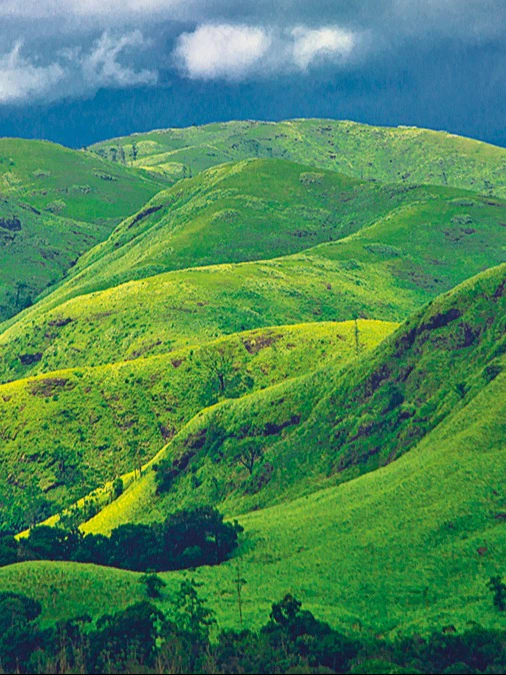
High in the upper reaches of the Western Ghats—above 1,500 meters—a unique, ancient landscape exists that defies common assumptions of tropical geography. Here, nestled inside the folds of rolling montane grasslands, are stunted, evergreen cloud forests known locally as **Sholas**. For millennia, the Shola-grassland mosaic has acted as a giant, hyper-efficient sponge, capturing misty monsoonal moisture and feeding the perennial streams that merge into the mighty Kaveri and Krishna rivers.
Yet today, these ancient cloud forests are amongst the most fragmented and threatened ecosystems on Earth. Decades of colonial-era forestry policies and post-independence agricultural expansions systematically replaced what was dismissed as "worthless scrub land" with industrial monocultures of commercial timber—namely Eucalyptus, Wattle (*Acacia mearnsii*), and Pine. The impact on local hydrology and native biodiversity has been catastrophic.
"The wattle did not just take the space of the grasslands; it drank the water table dry, choked the riparian channels, and silenced the ancient streams that have sustained the hills for five thousand years."
The Hydrological Cost of Monocultures
Invasive exotics like wattle and eucalyptus are biological pumps. Unlike native grasses and stunted Shola trees, which restrict transpiration to conserve moisture during the dry winter, exotics draw massive volumes of water year-round. Over the past four decades, hundreds of high-altitude streams have vanished, turning perennial rivers into seasonal torrents and triggering acute water scarcity for downstream farming communities.
Furthermore, these exotic species possess highly allelopathic properties; their leaf litter releases biochemical compounds that actively inhibit the germination of native seeds. In a matter of years, complex biodiverse grasslands are converted into sterile, monoculture vaults where native flora cannot survive and wildlife finds nothing to eat.
Did You Know?
Shola trees are stunted because of high-altitude winds and frost. Although they grow to only 6 to 10 meters in height, some of these slow-growing hardwoods are hundreds of years old and harbor unique epiphytes and mosses found nowhere else on the planet.
Painstaking Restoration: Reclaiming the Grasslands
Restoring this delicate ecosystem is not as simple as planting native saplings. It is a slow, methodical battle of ecological liberation. Working alongside local communities, the Kerala Forest Department and Caresys Foundation have pioneered a community-driven model focused on three distinct pillars:
- Invasive Eradication: The mechanical removal of mature wattle trees, followed by the rigorous uprooting of root networks and saplings. Since wattle seeds can lay dormant in the soil for up to 30 years, this requires annual clearing of re-emergent seedlings.
- Grassland Regeneration: Actively replanting native tussock grasses (*tussock grass* species) to anchor the fragile montane topsoil, prevent landslide erosion, and suppress weeds.
- Riparian Restoration: Establishing Shola nurseries in local tribal settlements, where native seedlings—such as *Syzygium*, *Rhododendron*, and *Michelia nilagirica*—are cultivated for 18–24 months before being transplanted into sheltered valleys.
| Ecosystem Feature | Exotic Monoculture (Wattle/Pine) | Restored Shola-Grassland Mosaic |
|---|---|---|
| Water Retention | Low (Rapid transpiration, dried streams) | High (Spongy soils recharge aquifers) |
| Biodiversity Support | Extremely Poor (Sterile understorey) | Exceptional (Endemic birds, Nilgiri Tahr) |
| Fire Resilience | Highly Flammable (Resinous leaf litter) | Resilient (Wet evergreen canopy buffers fire) |
| Soil Quality | Acidic and eroded | Rich humus layer anchoring nutrients |
Signs of Hope: The Streams Return
The labor is intense, but the ecological dividends are undeniable. In one of our project sites in the Munnar high ranges, where 50 hectares of dense wattle were cleared in 2023, a dormant mountain spring has begun flowing again. Endemic birds like the Nilgiri Pipit and the spectacular Nilgiri Laughingthrush have returned to breed in the emerging native grass cover.
This victory demonstrates a vital lesson for global forestry: restoration is not about "planting tree counts." True restoration is a long-term commitment to ecological memory—working with the soil, empowering local communities, and giving the ancient forests of the Western Ghats the quiet space they need to whisper their stories once more.